India’s healthcare system is in the middle of a massive digital shift. Over 600 million ABHA (Ayushman Bharat Health Account) cards have been created since the initiative launched, telemedicine consultations skyrocketed after COVID-19, and patients now expect the same digital convenience from their hospital that they get from ordering food on Swiggy.
And yet, walk into most mid-sized hospitals or clinics today, and you’ll still see front-desk phones ringing nonstop, patients waiting in line just to book a follow-up, and staff manually calling people to remind them about tomorrow’s appointment. It’s a bottleneck that doesn’t need to exist.
WhatsApp is already the default communication tool for most Indians. Patients message clinic numbers informally, share prescription photos in family groups, and expect quick replies. The opportunity isn’t about introducing a new channel — it’s about properly automating the one patients already use. If you’re new to this space, our complete guide to WhatsApp automation for business covers the fundamentals.
Why Healthcare and WhatsApp Are a Natural Fit
Before diving into specific use cases, it’s worth understanding why WhatsApp works so well for healthcare specifically.
The reach is unmatched. India has over 500 million WhatsApp users. That’s not a tech-savvy niche — it includes elderly patients, rural users, and people who might struggle with a hospital’s web portal but use WhatsApp daily to video-call their grandchildren.
Privacy is built in. WhatsApp’s end-to-end encryption means patient conversations aren’t floating around in plain text. While it’s not a replacement for full HIPAA-style compliance frameworks, the encryption layer addresses a genuine concern that hospitals have when using messaging platforms.
Rich media changes everything. Text messages can’t carry a lab report PDF, an X-ray image, or a video explaining post-surgery exercises. WhatsApp handles all of these natively. A patient can receive their blood test results as a PDF, view it on their phone, and forward it to a family member — all within the same app they use every day.
It’s two-way. Unlike SMS blasts, WhatsApp enables real conversations. A patient can reply to an appointment reminder to reschedule. They can ask a follow-up question after receiving discharge instructions. That interactivity is what makes automation on WhatsApp fundamentally different from traditional hospital communication.
10 WhatsApp Automation Use Cases That Actually Matter
Let’s get into the specifics. These aren’t theoretical ideas — they’re workflows that hospitals, diagnostic labs, and clinics across India can implement today.
1. Appointment Booking and Scheduling
This is the most obvious starting point, and for good reason. Phone-based appointment booking is painful for everyone involved. The patient waits on hold, the receptionist juggles multiple calls, and mistakes happen.
With WhatsApp automation, the flow looks something like this:
- Patient messages the hospital’s WhatsApp number
- Bot greets them and asks: “What would you like to do?” with options like Book Appointment, Check Reports, Talk to Support
- Patient selects “Book Appointment”
- Bot shows available departments — Cardiology, Orthopedics, General Medicine, etc.
- Patient picks a department, then selects a doctor from the available list
- Bot shows available time slots for the next few days
- Patient confirms, receives a booking confirmation with date, time, doctor name, and any pre-visit instructions
The entire process takes under two minutes. No hold music. No miscommunication. And the hospital’s front desk staff can focus on the patients who are physically present instead of being glued to the phone.
2. Appointment Reminders and Reducing No-Shows
No-shows are a real problem. When a patient doesn’t turn up for a scheduled appointment, that’s a slot wasted — revenue lost, and another patient who could’ve been seen wasn’t. Research suggests that automated reminders via SMS or WhatsApp can reduce no-show rates by 20-30%, depending on the setting and patient demographic.
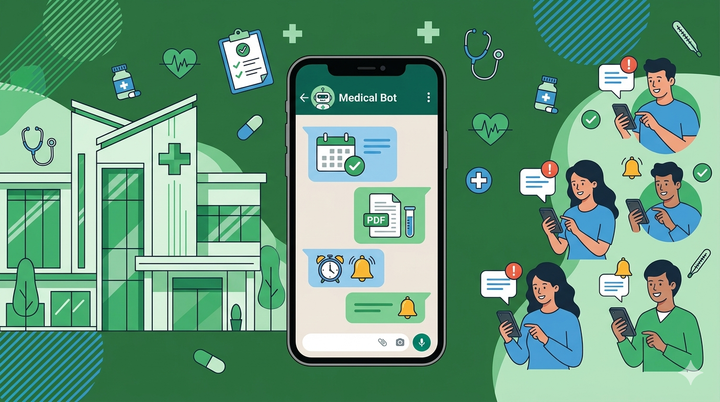
A solid reminder workflow sends two messages: one 24 hours before the appointment and another 1-2 hours prior. Each message includes the appointment details and — this is the key part — a quick reply option to confirm or reschedule. Something like:
“Hi Priya, this is a reminder for your appointment with Dr. Mehta (Dermatology) tomorrow at 11:00 AM, Block B, 3rd Floor. Reply CONFIRM to confirm or RESCHEDULE to pick a new time.”
That reschedule option turns a potential no-show into a rebooked appointment. The slot opens up for someone else, and the patient doesn’t feel guilty about cancelling because the process is frictionless.
3. Lab Report and Test Result Delivery
Most diagnostic chains and hospital labs in India still rely on web portals or physical collection for report delivery. The problem? Many patients, especially older ones, forget their portal credentials or simply don’t bother logging in.
WhatsApp solves this beautifully. As soon as a report is ready, the system sends a WhatsApp message with the PDF attached. The patient gets a notification they can’t miss, opens the report right there, and can share it with their doctor instantly.
For diagnostic labs processing hundreds of reports daily, this also cuts down on front-desk queries. “Is my report ready?” calls drop dramatically when patients know they’ll be notified on WhatsApp the moment results are available.
4. Prescription Reminders and Medication Adherence
The World Health Organization has noted that medication adherence for chronic diseases averages around 50% in developing countries. That’s a staggering number. Half the patients prescribed medication for conditions like diabetes, hypertension, or thyroid disorders aren’t taking it consistently.
Automated WhatsApp reminders won’t fix this entirely, but they help. A daily message at 8 AM saying “Good morning, Ramesh. Time for your Metformin (500mg). Take it with breakfast.” is simple, personal, and hard to ignore when it pops up on the same app you check fifty times a day.
For hospitals running chronic disease management programs, this kind of automation can meaningfully improve patient outcomes without adding workload to the care team. You set it up once per patient, and it runs on autopilot.
5. Pre-Visit Instructions
Every healthcare professional knows the frustration: a patient shows up for a fasting blood test having eaten breakfast, or arrives for an MRI wearing metal jewellery, or forgets to bring their insurance card. The appointment gets delayed or rescheduled, wasting time for everyone.
Automated pre-visit messages fix this. When an appointment is booked, the system sends relevant preparation instructions based on the type of visit:
- Blood test: “Please fast for 10-12 hours before your test. You may drink water. Carry your prescription and a valid ID.”
- Surgery prep: “Do not eat or drink anything after midnight. Wear loose, comfortable clothing. Bring your insurance documents and ABHA card.”
- First OPD visit: “Please carry all previous medical records, current medication list, and a valid photo ID. Arrive 15 minutes early for registration.”
These messages go out automatically based on the appointment type. No manual effort required. And the reduction in day-of confusion is significant.
6. Post-Discharge Follow-Up
What happens after a patient leaves the hospital matters just as much as what happens inside it. Poor post-discharge follow-up is a well-documented contributor to hospital readmissions, and readmissions are expensive — both for the patient and the institution.
WhatsApp automation enables structured post-discharge check-ins. A patient who’s had knee replacement surgery might receive:
- Day 1 post-discharge: Wound care instructions, medication schedule, and a reminder to keep the operated area elevated
- Day 3: “How are you feeling? Any swelling, redness, or unusual pain around the surgical site? Reply YES if you have concerns and we’ll connect you with the care team.”
- Day 7: Reminder about the follow-up appointment with the surgeon
- Day 14: Physiotherapy exercise video and a check-in on mobility progress
This kind of proactive outreach makes the patient feel cared for, catches complications early, and strengthens the hospital’s reputation for quality aftercare. Major hospital networks like Apollo, Fortis, and Max are all investing heavily in patient engagement for exactly this reason — post-discharge is where loyalty is built.
7. Health Package and Wellness Campaign Broadcasts
Hospitals and diagnostic labs run seasonal promotions constantly — monsoon health checkups, diabetes screening camps, annual wellness packages, vaccination drives. Traditionally, these campaigns rely on newspaper ads, SMS blasts, and maybe some social media posts.
WhatsApp broadcast messages are dramatically more effective for this. The open rates on WhatsApp are estimated at 90%+ compared to 20-25% for email, and the click-through rates reflect that gap. A well-crafted template message about a discounted full-body health checkup, sent to patients who visited in the last year, will generate more bookings than almost any other channel.
The key is segmentation. Don’t blast the same message to everyone. Send diabetes screening offers to patients with a family history. Promote cardiac checkups to men over 40. Target women’s health packages to relevant demographics. WhatsApp automation platforms let you segment your patient database and personalise broadcasts accordingly.
8. Insurance and Billing Queries
If you’ve ever worked at a hospital front desk, you know that insurance and billing questions consume an enormous amount of staff time. “Is this procedure covered under my policy?” “What’s the estimated out-of-pocket cost?” “What’s the status of my TPA approval?” “Can I get an itemised bill?”
A WhatsApp chatbot can handle the most common billing and insurance FAQs instantly. It can provide estimated costs for standard procedures, explain what documents are needed for cashless claims, share the list of empanelled insurance providers, and give real-time updates on TPA approval status if integrated with the hospital’s billing system.
For questions that are too complex or sensitive for a bot — disputed charges, claim rejections, special approvals — the system escalates to a human agent in the billing department. The bot handles the first 70-80% of queries, freeing up staff for the cases that genuinely need human judgement.
Want to automate patient communication on WhatsApp?
Inceptimind helps hospitals and clinics set up AI-powered WhatsApp chatbots with no coding required. Appointment booking, reminders, report delivery, and more — plans start at just ₹299/mo.
Get Started Today9. Doctor Availability and OPD Information
One of the most common reasons patients call a hospital is simply to check if a specific doctor is available on a particular day. “Is Dr. Sharma available this Saturday?” “What are the OPD timings for the ENT department?” “Which doctors are available for paediatrics in the evening?”
These are perfectly structured queries that a bot handles better than a human. The bot pulls from the hospital’s scheduling system and gives an instant, accurate answer. No hold time, no transfers between departments, no outdated information from a receptionist working off last week’s schedule.
Patients can check availability, see consultation fees, and book directly — all within the same WhatsApp conversation. For multi-specialty hospitals with dozens of doctors across multiple departments, this alone can cut phone call volume substantially.
10. Patient Feedback Collection
NABH accreditation requirements push hospitals to collect patient feedback systematically. But feedback forms at the discharge counter get filled out halfheartedly, email surveys go unopened, and phone-based surveys are expensive and intrusive.
WhatsApp feedback requests see significantly higher response rates than email. A simple message sent a few hours after the visit — “Hi Ananya, thank you for visiting City Hospital today. How would you rate your experience? Reply with a number from 1 (poor) to 5 (excellent).” — takes seconds to respond to. Follow up with an open-ended question for those who rate below 4, and you’ve got actionable feedback flowing in automatically.
Hospitals pursuing or maintaining NABH accreditation can use this data directly in their quality improvement processes. And for any healthcare provider, understanding patient satisfaction in near real-time is invaluable — you can catch service issues before they become patterns.
Getting Started with WhatsApp Automation for Your Hospital or Clinic
If you’re a hospital administrator or clinic owner reading this and thinking “this sounds great, but where do I actually start?” — here’s a practical path forward.
Start with one or two use cases, not all ten. Appointment reminders and OPD information are typically the easiest to implement and show quick results. You don’t need to automate everything on day one.
Pick a platform that doesn’t require a development team. You need a no-code solution where your operations team can build and modify flows without writing code. Look for platforms that offer a visual flow builder, knowledge base integration, and the ability to handle multiple channels from one dashboard.
Integrate with your existing systems where possible. The real power of WhatsApp automation comes when it’s connected to your HMS (Hospital Management System), appointment scheduler, and billing software. Even basic integrations — like pulling the day’s appointment list to trigger reminders — make a massive difference.
Get WhatsApp Business API access. The regular WhatsApp Business app won’t cut it for a hospital handling hundreds of patient conversations. You need the API, which allows chatbot integration, broadcast messaging, and multi-agent access. Understand the costs first with our WhatsApp API pricing breakdown for India. Most automation platforms, including Inceptimind, handle the API setup as part of onboarding.
Train your staff on the handoff process. Automation handles the routine stuff, but your team still needs to be ready for escalations. Make sure everyone knows how the bot-to-human handoff works and who’s responsible for which types of queries.
India’s healthcare industry is at an inflection point. Other industries are seeing similar transformations — real estate agents are using WhatsApp chatbots to qualify leads and book site visits around the clock. Between government digital health initiatives, rising patient expectations, and the sheer volume of people seeking care, hospitals and clinics that embrace smart automation won’t just improve efficiency — they’ll deliver a fundamentally better patient experience. WhatsApp is where your patients already are. The only question is whether you’ll meet them there with a manual process or an intelligent one.