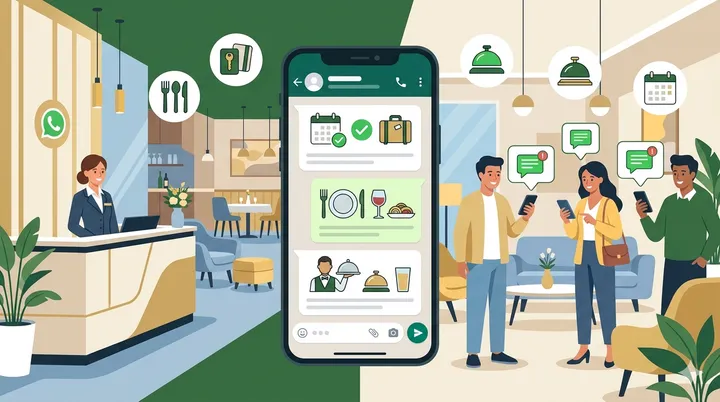
India’s hospitality industry is worth over $25 billion, according to IBEF, and it’s growing at a clip that shows no sign of slowing down. From luxury chains like Taj and ITC to budget-friendly brands like Lemon Tree and OYO, there’s a massive spectrum of hotels, restaurants, and cafes competing for the same guest.
Here’s the thing — whether you run a boutique hotel in Goa, a restaurant chain in Mumbai, or a cozy café in Bangalore, your customers are already on WhatsApp. Over 500 million Indians use it daily. They’re sharing trip plans in group chats, sending food photos to friends, and yes, expecting businesses to be available there too.
But most hospitality businesses still rely on phone lines that go busy during peak hours, emails that get buried in inboxes, and OTA platforms that quietly eat 15-25% of every booking as commission. That’s a lot of money walking out the door.
WhatsApp chatbots fix all three problems. Instant responses, direct bookings, zero commission. Let’s break down exactly how this works for hotels, restaurants, and cafes.
Why Hospitality and WhatsApp Are a Natural Fit
Before we get into specific use cases, it’s worth understanding why WhatsApp isn’t just another channel — it’s arguably the best channel for hospitality.
Your guests already have it. With 500M+ users in India alone, you don’t need to convince anyone to download a new app. WhatsApp is already on their phone, and they check it dozens of times a day.
Rich media makes all the difference. You can send room photos, PDF menus, location pins, video tours, and booking confirmations — all within the same chat. Try doing that over a phone call.
It’s genuinely two-way. Unlike SMS blasts or email newsletters, guests can ask follow-up questions, request changes, or raise concerns right there in the conversation. That’s how real hospitality works.
24/7 availability matters more than you think. An international traveler in a different time zone shouldn’t have to wait until your front desk opens to ask about airport transfers. A chatbot doesn’t sleep.
And then there’s the money. Direct bookings through WhatsApp mean zero OTA commission. We’ll get into the math later, but the savings are substantial — especially for independent properties.
8 Ways Hotels, Restaurants, and Cafes Use WhatsApp Chatbots
These aren’t theoretical ideas. They’re practical use cases that hospitality businesses across India are already putting to work.
1. Room Booking and Reservation Inquiries
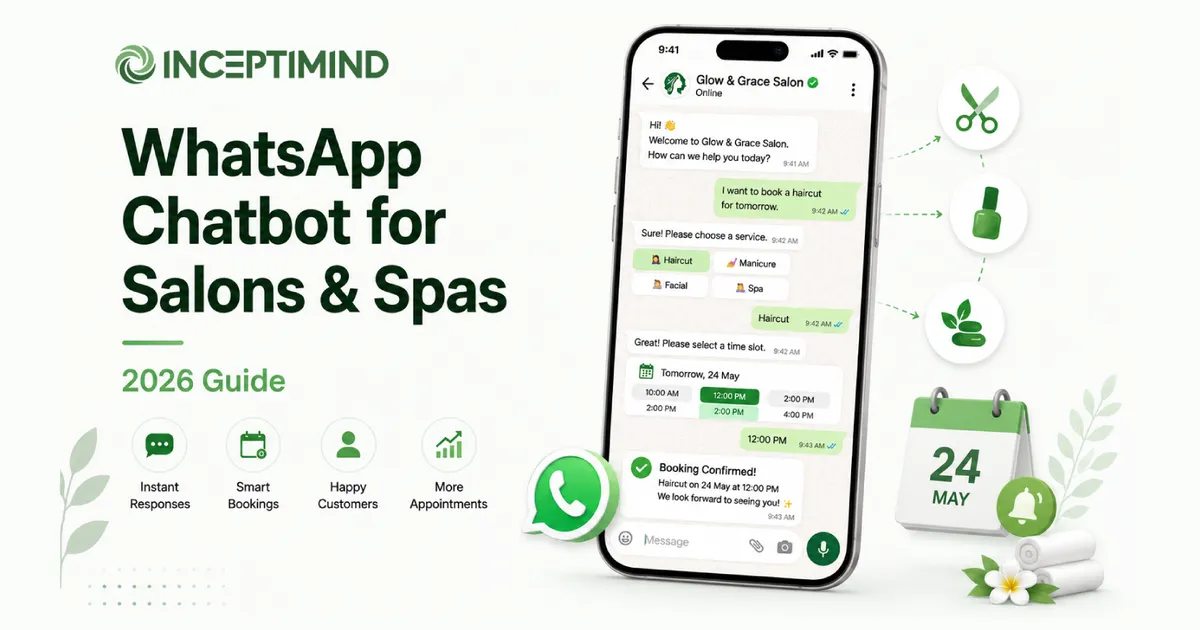
This is the big one. A potential guest messages your WhatsApp number asking about availability. Instead of waiting for a receptionist to check and call back, the chatbot handles it instantly. The same WhatsApp booking flow that powers clinic and salon appointments handles room availability and table reservations too.
Here’s what a typical flow looks like:
- Guest sends “Hi, do you have rooms available for this weekend?”
- Bot asks for check-in date, check-out date, and number of guests
- Bot shows available room types with photos, amenities, and pricing
- Guest selects a room and confirms
- Bot collects guest details and sends a booking confirmation with a payment link
The entire interaction takes two to three minutes. No phone tag, no back-and-forth emails, no abandoned inquiries because the front desk was busy with a check-in.
For a deeper dive into setting up these automated flows, check out our complete WhatsApp automation guide.
2. Restaurant Table Reservations
Table reservations through WhatsApp are beautifully simple. The bot collects the date, preferred time, party size, and any dietary preferences or special requests (birthday dinner, high chair needed, window seat preference). Then it sends a confirmation message with all the details.
What makes this better than a phone reservation? The guest has a written record they can refer back to. No more “I thought I said 8 PM, not 7 PM” situations. And during the Friday evening rush when your host is juggling walk-ins, the bot keeps taking reservations without missing a beat.
3. Reducing No-Shows with Automated Reminders
No-shows are a genuine headache for restaurants. You’ve held a table, possibly turned away other guests, and the reservation just… doesn’t show up.
Automated WhatsApp reminders sent 24 hours and 1 hour before the reservation make a real difference. Industry data from platforms like OpenTable and Dineout suggests that timely reminders can reduce no-shows by 25-40%.
The smart part? Include a reschedule button right in the reminder. Something like:
“Hi Priya! Just a reminder — your table for 4 at The Garden Bistro is confirmed for tomorrow at 8 PM. Can’t make it? Tap below to reschedule or cancel.”
A guest who reschedules is infinitely better than a guest who just doesn’t turn up. You free the table and keep the relationship.
4. Digital Menu and Room Service Orders
Nobody wants to call the front desk for room service at midnight. And let’s be honest — those laminated in-room menus aren’t exactly inspiring.
With a WhatsApp chatbot, guests can browse an interactive digital menu right in their chat. Use WhatsApp’s list messages and reply buttons to let them pick categories (starters, mains, desserts, beverages), select items, customize their order (extra spicy, no onions), and confirm.
For restaurants and cafes, this also works for takeaway orders. A customer messages, browses the menu, places an order, gets an estimated time, and picks it up — or gets it delivered. It’s similar to what platforms like Swiggy and Zomato offer, except you’re not paying 25-30% in commissions.
5. Check-in and Check-out Automation
The pre-arrival experience sets the tone for the entire stay. A WhatsApp chatbot can handle this smoothly:
Before arrival:
- Send a welcome message with property details and directions
- Collect ID proof and guest details via chat (guests upload photos of their Aadhaar or passport directly)
- Offer early check-in if available
- Ask about special requests — extra pillows, airport pickup, dietary needs
At checkout:
- Send an express checkout option via WhatsApp
- Share the final bill as a PDF
- Collect quick feedback while the experience is fresh
- Offer a direct booking discount for their next stay
This isn’t about replacing human interaction — it’s about handling the paperwork so your staff can focus on the warm welcome and personal touches that guests actually remember.
6. Concierge and Local Recommendations
“What’s a good restaurant nearby?” “Can you book a taxi to the airport?” “What time does the spa close?” “Are there any local tours you’d recommend?”
Your front desk probably fields these questions fifty times a day. A WhatsApp chatbot handles the repetitive ones instantly — nearby attractions with Google Maps links, spa timings and booking, taxi service contacts, restaurant recommendations — while escalating complex or unusual requests to your team.
Think of it as a digital concierge that handles the FAQ layer, freeing your actual concierge to provide the thoughtful, personalized recommendations that make a stay memorable.
7. Guest Feedback and Review Collection
Here’s something most hotels get wrong: they send a feedback email three days after checkout. By then, the guest has moved on. Response rates for post-stay emails typically hover around 5-10%.
WhatsApp messages, on the other hand, get opened. Industry data consistently shows WhatsApp message open rates above 90%. Send a quick feedback request on the day of checkout, and you’ll get significantly more responses.
The clever move? Route happy guests (those who rate 4 or 5 stars) directly to your Google Reviews page. A guest who just told you they had a great stay is far more likely to leave a public review when you make it one tap away.
For guests who aren’t happy, route them to your support team. You get a chance to fix the issue privately before it becomes a public review. That’s good hospitality and good business.
8. Promotional Campaigns and Loyalty
WhatsApp broadcast lists are incredibly effective for hospitality promotions. Seasonal offers, weekend getaway packages, monsoon discounts, loyalty rewards — these messages actually get read.
Where email marketing campaigns typically see open rates of 15-25%, WhatsApp broadcasts consistently deliver much higher engagement. A well-timed message about a long weekend package, sent to guests who’ve stayed with you before, can drive direct bookings without spending a rupee on ads.
Just don’t overdo it. One or two broadcasts a month is plenty. Nobody wants to mute their favourite hotel. For more on what this costs, here’s our breakdown of WhatsApp API pricing in India.
{% bloginlinecta %}
The OTA Commission Problem (and How Direct Bookings Fix It)
Let’s talk numbers, because this is where WhatsApp chatbots go from “nice to have” to “we should have done this yesterday.”
Hotels typically pay 15-25% commission to OTA platforms like MakeMyTrip, Booking.com, and Goibibo. On a room priced at ₹5,000 per night, that’s ₹750 to ₹1,250 going to the OTA for every single booking.
Now consider a small hotel with 30 rooms, averaging 70% occupancy. That’s roughly 21 rooms sold per night, or about 7,665 room-nights per year. If even half of those come through OTAs at an average commission of 20%, you’re looking at:
3,832 room-nights x ₹5,000 x 20% = ₹38.3 lakhs per year in commissions.
That’s a staggering amount. And it goes straight to the OTA, not into improving your property or paying your staff better.
Now, what if you shifted just 20% of those OTA bookings to direct WhatsApp bookings? That’s 766 room-nights where you pay essentially nothing — just the WhatsApp API cost of roughly ₹0.78 per marketing conversation.
Savings: approximately ₹7.6 lakhs per year.
That’s the salary of a full-time staff member. Or a room renovation. Or a marketing budget that brings in even more direct bookings. The point is — it’s real money, and WhatsApp chatbots are one of the most practical ways to capture it.
You don’t need to eliminate OTAs entirely. They’re still great for discovery and filling rooms during low season. But every booking you convert to direct is pure margin improvement.
How to Get Started
Setting up a WhatsApp chatbot for your hotel, restaurant, or cafe doesn’t require a development team or months of planning. Here’s the practical path:
Step 1: Pick the right platform. You need a WhatsApp Business API provider with a no-code flow builder. Inceptimind offers exactly this — a visual drag-and-drop builder where you design conversation paths without writing a single line of code. Plans start at ₹399/month, which is a fraction of what you’d spend on a single OTA commission. Check out the full feature set and pricing.
Step 2: Build your top use cases first. Don’t try to automate everything on day one. Start with the highest-impact flows — room booking inquiries, table reservations, or menu sharing, depending on your business. Get those running smoothly, then expand.
Step 3: Promote your WhatsApp number everywhere. Add it to your website, Google Business profile, Instagram bio, printed materials, and in-room signage. Use QR codes — guests can scan and start chatting instantly. The more discoverable your WhatsApp channel, the more direct bookings you’ll capture.
Step 4: Monitor and improve. Track which conversations lead to bookings, where guests drop off, and what questions the bot can’t answer. Use those insights to refine your flows over time.
If you’re exploring automation across other industries too, you might find our piece on WhatsApp automation for healthcare interesting — many of the same principles apply.
Wrapping Up
The hospitality industry runs on guest experience. And right now, the guest experience often starts with a frustrating phone call or an impersonal OTA listing. WhatsApp chatbots change that equation — instant responses, rich conversations, direct bookings, and genuine 24/7 availability.
Whether you’re a 200-room hotel or a 10-table restaurant, the fundamentals are the same. Your guests are on WhatsApp. Meet them there.
Ready to set up WhatsApp automation for your property? Get in touch with our team and we’ll help you build the right flows for your business.