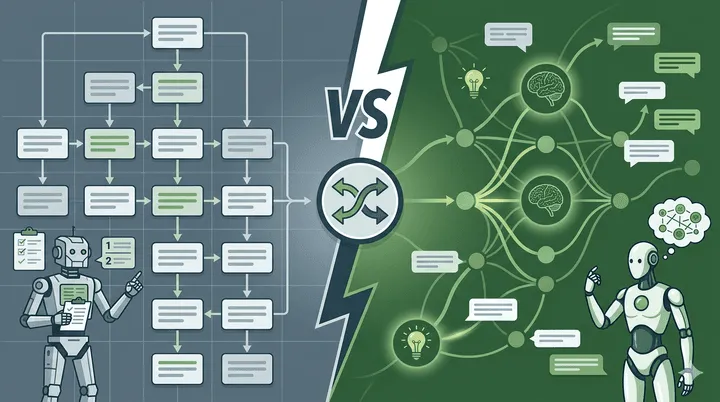
Chatbots have become a standard part of business communication. From answering customer questions at midnight to qualifying leads while your team sleeps, they handle an enormous volume of interactions every day. But not all chatbots are created equal. The two dominant architectures — rule-based and AI-powered — work in fundamentally different ways, and picking the wrong one can cost you months of effort and thousands of rupees.
In this guide, we’ll break down how each type works, compare them across the metrics that actually matter, and explain why a growing number of businesses are going hybrid — combining the best of both.
What Is a Rule-Based Chatbot?
A rule-based chatbot (sometimes called a flow-based or decision-tree chatbot) follows a predefined script. Think of it as an interactive flowchart: the user picks an option, and the bot responds with the next set of options. There’s no guesswork involved — every conversation path is mapped out in advance by whoever builds the bot.
How It Works
Rule-based bots operate on an if-then logic model. If the user types “1” or clicks “Track my order,” the bot returns the order-tracking response. If the user types something the bot was not programmed to handle, it either repeats the menu or displays a fallback message like “Sorry, I didn’t understand that.”
Common implementations include:
- Button menus: The user selects from a list of options at each step (e.g., “Press 1 for Sales, 2 for Support”).
- Keyword matching: The bot scans for specific words like “refund” or “delivery” and routes the user to the corresponding flow.
- Decision trees: A branching structure where each answer leads to a different branch, eventually arriving at a resolution.
Strengths of Rule-Based Bots
- Predictable: Every response is authored by a human, so you know exactly what the bot will say in every scenario.
- Fast to build: A simple FAQ bot with 10-15 flows can be live in a day.
- Low cost: No AI model inference costs. The bot is essentially a series of conditional statements.
- Easy to audit: Compliance-heavy industries (banking, healthcare) can review and approve every response before it goes live.
Limitations
- Rigid: If the user phrases something in a way the bot does not expect, it breaks.
- Maintenance burden: As your product or service grows, the number of flows grows exponentially. A bot with 50 flows is already painful to manage.
- No learning: The bot never improves on its own. Every new scenario requires manual programming.
What Is an AI Chatbot?
An AI chatbot uses natural language processing (NLP) and, increasingly, large language models (LLMs) to understand what a user is asking — even when the phrasing is informal, misspelled, or completely unexpected. Instead of following a flowchart, it interprets the intent behind the message and generates a response dynamically.
How It Works
Modern AI chatbots typically combine several components:
- Intent recognition: The model identifies what the user wants (e.g., “I want to cancel my subscription” maps to the intent “cancel_subscription”).
- Knowledge base retrieval: The bot searches a curated set of documents — FAQs, product manuals, policy pages — to find the most relevant information.
- Contextual memory: The bot remembers earlier messages in the conversation, so the user does not have to repeat themselves.
- Response generation: Using the retrieved context, the model produces a natural, human-sounding answer.
Strengths of AI Chatbots
- Flexible: Handles open-ended questions, spelling mistakes, slang, and multi-turn conversations.
- Scalable: Adding new knowledge is as simple as uploading a document. No new flows to build.
- Continuously improving: AI models can be fine-tuned with real conversation data to get better over time.
- Reduced agent workload: Industry research suggests that AI chatbots can handle up to 80% of routine customer inquiries without human intervention.
Limitations
- Less predictable: Generated responses can sometimes be off-topic or include information the business did not intend to share.
- Higher setup effort: Curating a good knowledge base and training the model takes more upfront work.
- Cost: LLM inference has a per-token cost. High-volume deployments need careful cost management.
Side-by-Side Comparison
Here’s how the two approaches stack up across the dimensions that matter most:
| Criteria | Rule-Based Chatbot | AI Chatbot |
|---|---|---|
| Understanding | Keyword and pattern matching only | Natural language understanding, handles typos and slang |
| Flexibility | Limited to programmed paths | Handles unexpected questions and open-ended queries |
| Setup Time | Hours to days | Days to weeks (knowledge base curation) |
| Maintenance | High (manual updates for every new scenario) | Low (upload new documents, retrain) |
| Cost per Interaction | Very low (no inference cost) | Moderate (token-based pricing) |
| Accuracy | 100% for known paths, 0% for unknown | High overall, occasional hallucination risk |
| Scalability | Difficult beyond 50+ flows | Scales with knowledge base size |
| Personalization | Minimal (same path for everyone) | Context-aware, adapts to user history |
| Best For | Structured tasks, menus, order tracking | Complex queries, product discovery, support |
When to Use a Rule-Based Chatbot
Rule-based bots aren’t outdated — they’re the right tool for specific jobs. Consider a rule-based approach when:
- The user journey is structured: Restaurant ordering, appointment booking, and lead qualification forms all follow a predictable sequence. A flow-based bot handles these efficiently without any AI overhead.
- You need deterministic responses: In regulated industries like finance or healthcare, every bot response may need legal review. Rule-based bots give you that control.
- Volume is low and topics are narrow: A small business with 10 common questions does not need NLP. A simple menu bot gets the job done.
- Budget is tight: If you are starting out and want a chatbot live in one afternoon with zero recurring AI costs, a rule-based bot is the practical choice.
When to Use an AI Chatbot
AI chatbots shine when conversations are unpredictable or when the information space is large. Consider AI when:
- Customers ask open-ended questions: “What’s the best plan for a team of 5?” or “Can I integrate this with my Shopify store?” — these require understanding, not a menu.
- Your product catalog is large: An e-commerce store with 500 products cannot create a flow for every item. An AI bot can search the catalog and recommend products in natural language. See how this works in practice in our guide on automating Instagram DMs for e-commerce.
- You want to reduce support tickets: AI bots can resolve complex queries — returns, troubleshooting, policy questions — that would otherwise land in your support queue.
- Multilingual support is needed: Modern LLMs handle Hindi, Tamil, Bengali, and dozens of other languages without building separate flows for each.
Not sure which approach fits your business? Inceptimind's platform supports both rule-based flows and AI-powered conversations -- and you can combine them. Talk to our team to find the right setup.
Get in TouchThe Hybrid Approach: Why You Don’t Have to Choose
Here’s what most chatbot articles miss: the best-performing bots in production are almost never purely rule-based or purely AI. They use a layered system that routes each message to the most appropriate handler.
Consider what happens when a customer sends “I want to reorder the same items as last month” to a food delivery business:
- A rule-based bot would not understand this at all (it was not programmed for this exact phrase) and would show the main menu.
- A pure AI bot might understand the intent but lack access to the order history system, producing a vague response.
- A hybrid bot recognizes the intent via AI, triggers a structured flow to pull up the last order via an API call, and confirms the reorder with a button-based confirmation step.
This layered approach gives you the natural language understanding of AI with the precision and control of flows.
Inceptimind’s 3-Layer System
Inceptimind’s platform is built around this exact philosophy. Every incoming message passes through a 3-layer routing system:
- Pattern Match Layer: First, the system checks if the message matches a keyword trigger or a predefined pattern. If it does, the corresponding flow executes immediately. This handles greetings, menu commands, and structured inputs with zero latency and zero AI cost.
- Flow Layer: If the user is already inside an active flow (e.g., filling out a lead form or navigating a product catalog), the flow engine takes over. The conversation stays on track without AI intervention.
- AI Layer: If neither the pattern match nor an active flow handles the message, it goes to the AI engine. The AI searches the knowledge base, understands the context from previous messages, and generates an intelligent response.
This architecture means you only use AI when you genuinely need it, keeping costs low while ensuring no customer query goes unanswered. You can see how this works in practice on the How It Works section of our site.
Real-World Example
Here is how this might look for a real estate business using Inceptimind:
- Pattern triggers handle “hi,” “hello,” and “menu” — instantly showing a welcome message with buttons for Sales, Rentals, and Support.
- Structured flows manage property inquiries: the bot collects budget, location preference, and BHK configuration step by step.
- AI handles everything else: “Do you have 3BHK apartments near Whitefield with a gym?” gets answered by the AI using the agency’s property database as a knowledge base.
With this setup, the majority of incoming WhatsApp inquiries can be fully resolved by the bot, and response times drop from hours to seconds.
How to Get Started
If you’re evaluating chatbot options for your business, here’s a practical starting point:
- Audit your conversations: Look at your last 100 customer messages. How many follow a pattern (order status, pricing, hours)? How many are open-ended? This ratio tells you how much AI you actually need. For a step-by-step walkthrough, check out our complete guide to WhatsApp automation for business.
- Start with flows for structured tasks: Build rule-based flows for your top 5-10 most common interactions. These are quick to set up and immediately reduce manual work.
- Add AI for the long tail: Upload your FAQ documents, product guides, and policy pages to a knowledge base. Let the AI handle the diverse, unpredictable questions that flows cannot cover.
- Monitor and iterate: Use analytics to see which queries the AI struggles with. Turn frequently asked AI questions into dedicated flows for faster, cheaper resolution.
Inceptimind makes this entire process straightforward with a no-code builder, built-in knowledge base, and analytics dashboard — all starting at just ₹399/mo. Whether you need a simple menu bot today or a full AI assistant tomorrow, the platform grows with you.
The Bottom Line
Rule-based chatbots and AI chatbots are not competitors — they are complementary tools. Rule-based bots excel at structured, predictable interactions where speed and control matter. AI bots handle the messy, unpredictable, open-ended conversations that would be impossible to script in advance.
The smartest approach is to use both. Start with flows for what you can predict, layer in AI for what you cannot, and let a routing system like Inceptimind’s 3-layer architecture decide which engine handles each message. Your customers get fast, accurate answers every time — and your team spends less time answering the same questions over and over.